Thursday, September 28, 2006

First professional astronomer in the U.S.

Is the continue of Some Interestion on Science..........

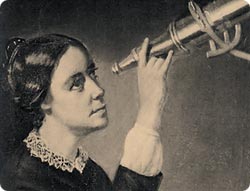
Maria Mitchell lived during the mid-1800s: a turbulent time when women were thought to be unworthy of higher education. Raised on Nantucket, in a broad-minded Quaker family, Maria rose above the prejudices that ruled her day to become the US's first professional astronomer.

Few girls of the time were lucky enough to have a father as broad-minded as William Mitchell. He taught her how to use a telescope, how to calibrate a chronometer, and encouraged her talent for science and mathematics. One of her earliest accomplishments was calibrating a chronometer (an instrument on which the safety of the crew depended) for Captain Chadwick, when her father was away. Unlike the other Mitchell children who found astronomy tedious, Maria quickly grasped mathematical principles and loved doing complicated calculations. At 16, Maria became a teaching assistant to a schoolmaster. The doors of the best colleges in the US were closed to her as a woman, and she could not immediately consider a professional career in astronomy. She later became a librarian and devoted her evenings to the study of the stars. Her position as a librarian also allowed her to continue her self-study of astronomy.

William Mitchell was loaned a telescope to conduct observations for the US Coast Survey, and Maria began to assist him. In 1847, Maria discovered a comet using their rooftop telescope. For this discovery, the King of Denmark gave her a medal. Her discovery also made her a celebrity and allowed her to travel widely through the U.S. and Europe. Maria set up an observatory behind the schoolhouse in Nantucket. She studied sunspots and double stars and wrote papers about astronomical events.

Saturday, September 23, 2006

Some Interesting on Science……

Men, in India and elsewhere around the world, have largely dominated the world of science and mathematics. But is this due to nature or nurture? Is there something biological that predisposes men to science and drives women away from it?

There is a growing body of research that proves otherwise. Societal values have long been forcibly imposed on female scientists, mathematicians and engineers, forcing them into second place. Despite subtle and overt expressions of oppression, however, there have been women who have excelled and become leaders in these fields.
Unfortunately, their contributions are often not given the recognition they deserve.

Everyone has heard of Einstein, but how many have heard of Emmy Noether, the mathematician whose work was invaluable to him, and whom he described as the greatest mathematical genius of all time? Many people attribute the discovery of the planet Uranus to William Herschel; yet few know that his sister toiled beside him, completed all the complicated mathematical calculations and countless minutiae that helped him in his research.

It would be impossible to chronicle the lives and contributions of the many women whose names are not as famous as they should be. Many died before their contributions were recognized, and thus their lives were not well documented. Let we explore the world of women scientists, technologists, engineers and mathematicians, and some females who made vital contributions to their fields in coming days.
Backspace { FLOAT }

An amazing shortfilm.

Friday, September 15, 2006

What We Are

What we are

Monday, September 04, 2006

Hero Steve Irwin died:(


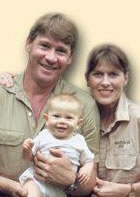
Steve Irwin famously known as The Crocodile Hunter have been killed by a stingray barb that went through his chest, while swimming to film a documentary. more here....

Steve Irwin is a super hero of catching Crocodile. He makes documentary films with Crocodile and Reptiles for the televisions he hosted with his American Wife Terri Steve. Its been long I watched his shows in Discovery and Animal Planet. I love his shows and wonder of his brave act, it was very shocking to know about his death. We missed a real hero, his praise will be every where in this world, his memorise are undestroyed for his fans.

God beless his soul and my heart fell solace for every one who miss him, esp. for his cute Baby Robert known as Lil' Croc hunter.
Steve Irwin, Wife Terri and Little Hunter Robert

Friday, August 25, 2006

Saturday, August 12, 2006

We are One!


[ 44 more to go...]

Wednesday, August 09, 2006

Not mindless mimics


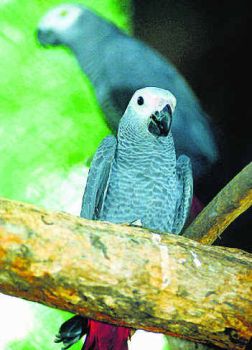
The image of parrots as mindless mimics has been challenged by a 30-year study that has found they can add, recognise shapes and colours and identify up to 100 different objects. The scientist publishing the research says that parrots, whose brains are almost the size of walnuts, compare with chimpanzees and dolphins in having a level of intelligence similar to that of small children. Their communication skills are similar to those of a two-year-old child, but their adding and ability with colours and shapes are more like a five or six-year-old, said Irene Pepperberg, associate professor of psychology at Brandeis University in Waltham, Massachusetts, U.S.

She carried out her research with African grey parrots. Although her work was ridiculed at first, the depth of research has gained the respect of other scientists, who increasingly accept her arguments. Professor Pepperberg will publish her latest results in the journal Applied Animal Behaviour Science. Alex, the most accomplished of her birds, is able to name seven colours and five shapes and count or add up to six. He can identify, request and refuse about 100 different objects and uses phrases such as come here and wanna go. He can also understand concepts such as zero, objects being bigger and smaller than one another, and the same or different. In one experiment, Alex was presented with collections of four, five and six blocks of three different colours and was able to provide the correct answer: Four blue.

Thursday, August 03, 2006

Multiple Intelligences

I want my children to understand the world, but not just because the world is fascinating and the human mind is curious. I want them to understand it so that they will be positioned to make it a better place. Knowledge is not the same as morality, but we need to understand if we are to avoid past mistakes and move in productive directions. An important part of that understanding is knowing who we are and what we can do... Ultimately, we must synthesize our understandings for ourselves. The performance of understanding that try matters are the ones we carry out as human beings in an imperfect world which we can affect for good or for ill. (Howard Gardner 1999: 180-181)
[Continue reading the full article]

[VIA The CosmicCode Institute]

Friday, July 28, 2006

Sleeping away their blues


Humans are not the only creatures who love their sleep. Animals too love tosleep, though their sleeping routine follows a strange pattern. We know that bears, ground hogs and opossums sleep all through winter. Though once in a while they do wake up. Can you believe that there are a few animals that sleep or hibernate right into spring without opening their eyes even once? These great sleepers are woodchucks and ground squirrels, their body temperatures dropping to near freezing point while they hibernate. Though a woodchuck may be the longest sleeper in the animal kingdom, they are in no way the strangest. The extremely naughty and playful sea otter takes his much needed sleep floating on its back in the water. The sea otter anchors itself to a piece of seaweed so that it will not drift off while sleeping. The otter's fine fur keeps the animal warm and cosy during its watery nap.

Bats sleep while hanging upside down and their favourite places are caves. Fish sleep with their eyes wide open, because the poor creatures have no eyelids to shut. But there is a particular type of fish that does not sleep at all. You guessed it, it is the shark.

The Alaskan blackfish takes the prize for being the strangest sleeper. When the cold Arctic winter comes, the waters, which are home to the blackfish, freeze. The black fish too freezes. Most people would assume that the black fish is dead. But the blackfish does not die but is in a state of suspended animation. Because a few months later with the arrival of spring the ice starts to melt and the black fish comes back to life. The walrus, like the whales and seals, enjoys travelling solo in the sea. But when it is time to snooze they all group together. They use their tusks to pull themselves up onto ice floes and lie down for a snooze, sometimes several hundred of them on one floe! All through the night members of the group take turns watching for attacking polar bears and killer whales. If one is spotted the guard flops over his friends and dives into the water, followed by his sleepy companions.